What’s inside: What kinds of toys & gifts are best for kids? And for their brains? Here are 4 Points from Charlotte Mason philosophy to help.
This post may contain affiliate links. If you find my content valuable and make a purchase through one of my links, I will earn a commission at no cost to you, which helps me keep this blog going so I can help you even more! I recommend products I trust and/or use myself, and all opinions I express are my own. Read the full disclaimer here.
Please note: this article is mostly centered on theory. If you want actual suggestions, please visit our Amazon Storefront.
Appropriate Toys & Gifts for Kids
According to Charlotte Mason, we should approach toys and gifts for children in such a way as to open up possibilities. A toy should never be “finite” and leave no room for the child’s imagination.
Let’s look at this in more detail.
1. Imagination
Of course, “imagining” is mentioned as one of the habits to cultivate in children. And yes, you can build habits that help your child’s brain grow.
As for imaginative toys…
If you want to understand the “finite” in imagination, a simple example is to compare a book with TV or movies. With a book, the child imagines the story in their mind. With TV, the imagination is restricted somewhat because the story has been played out visually.
That’s not always or necessarily bad – think of how an illustrated children’s book can ignite the imagination through visual imagery.
But it’s a restriction nonetheless.
Now move on to something more restrictive as we talk about toys themselves.
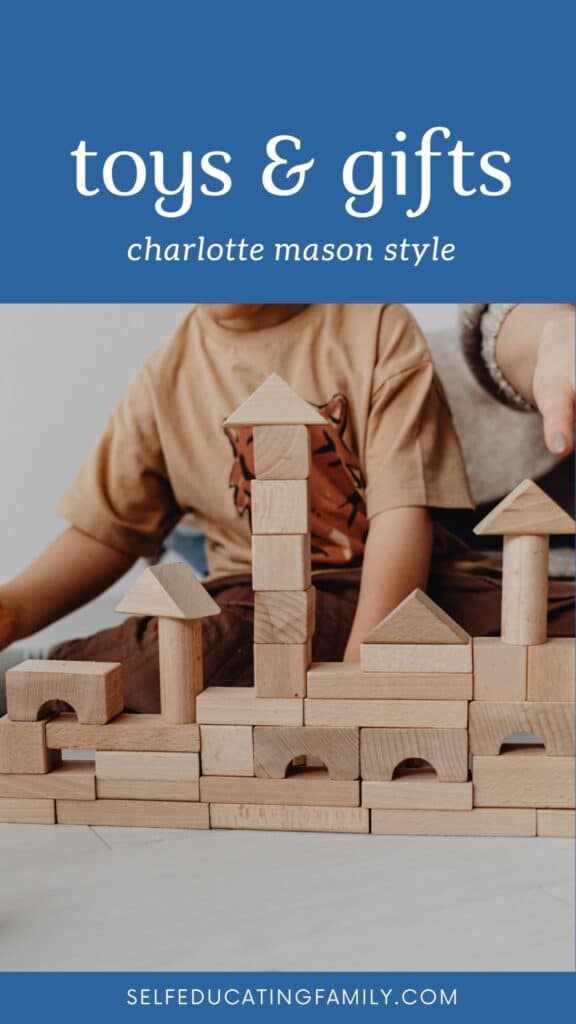
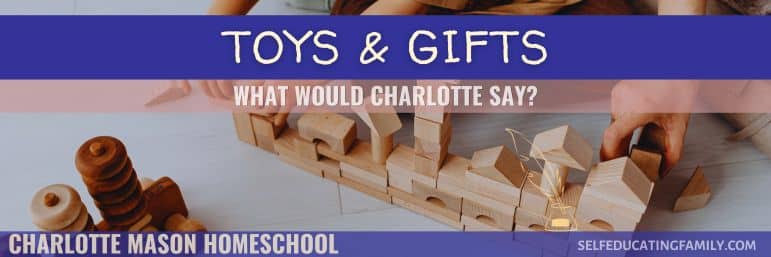
Picture a child playing with plain ordinary wooden blocks. How many different scenarios does that child come up with? A single block is transformed into a building, a road, a car, a person, a castle, and on and on the list goes.
Then picture a young child playing with a plastic toy that has lots of colorful buttons to push that make noise and pop up a picture. I’m thinking of a specific toy my kids received as a gift. It was actually an extremely annoying loud squeaky phone toy that spoke specific sounded like nails on a chalkboard when the buttons were pushed. The thing was LOUD and had no volume button!
And we received 2 of them, one for each twin!
I kindly left the toys at the relative’s house who gave them the gifts so they could “play with them when we visit.”
Remarkably, they did love to push those buttons. But maybe it was because they liked the reaction on the adults.
But it was NOT a good toy.
Open-ended Toys and Books
In an article by Mrs. C. Hatchell called “Our Children’s Play: Their Toys and Books,” (The Parents’ Review, Volume 17 (1906), p. 366), the author points out the difference between a “finite” toy and a “suggestive”. The suggestive toy will open up opportunities for imaginative play and “are certainly valuable ‘in promoting plays as they appeal to the child’s heart, and aid his imagination.’”
One special thing to consider is, to give when possible something out of which the child can make other things, or can do something more with. – Mrs. C. Hatchell
The point here is to select toys that leave an open invitation to the imagination.
2. Don’t Stultify
Such a fun word! Not very common in usage.
She uses it when describing “education is an atmosphere”.
It stultifies a child to bring down his world to a ‘child’s’ level.” — Home Education (Volume 1), Preface, p. 6
Charlotte Mason’s idea here is that by modifying the world to be “a child environment”, you disregard the educational value of the home atmosphere. You can read more about her “Principle #5” which is also listed in front of every volume of her book.
By filling the home atmosphere with child adaptations of the real world, you don’t allow the child to approach the real world on their own. Which is better because they can make their own connections that way.
Examples
Back to my boys’ annoying toy phones. The child sees you on your phone and wants to be like you and so starts pushing buttons on the toy phone.
Maybe the child should see you doing something other than pushing buttons on your phone. But that’s a different topic, isn’t it?
Let’s move to the kitchen.
The child sees you baking cookies and wants to do the same. So you give them a play kitchen. Now, that might not be a bad toy from a finite/suggestive point of view. But is it stultifying? Could you give them a step stool and their own apron and teach them simple cooking? It depends on what works for your family.
I had an “easy-bake oven” when I was little. You could totally make a real cake in it using a light bulb for heat. But I soon outgrew it and moved on to the real oven as fast as possible. I remember “writing” a cookbook when I was six with my favorite recipes, like “Rooney Eggs” named after my Uncle Gene Rooney who I think invented them, if you can invent scrambled eggs.
In this case, the toy was given because I had expressed interest in cooking. But the “stultifying” factor limited its long-term use for me. Plus the cakes were really small. I mean, I could easily polish off a couple of those little babies without thinking about it. Yet, I’d have to wait for the next one to bake.
The point: Toys & gifts should elevate the child and not come down to “their level.”
3. Real world
To a very young child, play is how they learn.
The child has truly a great deal to do before he is in a condition to ‘believe his own eyes’; but Nature teaches so gently, so gradually, so persistently, that he is never overdone, but goes on gathering little stores of knowledge about whatever comes before him.
And this is the process the child should continue for the first few years of his life. Now is the storing time which should be spent in laying up images of things familiar.
— Charlotte Mason, Volume 1, Home Education, page 66.
By the way, Ambleside Online has a lovely modern English version of Charlotte’s writings which clarifies how the child uses his senses to gain knowledge of the world.
The use of nature and allowing the child to learn in nature helps the very young to make sense of their world. Their real world.
So a day spent outside making sandcastles on the beach is better than a plastic sand castle toy. Although, we did have a fabulous little plastic catapult someone gave us. Here still, I bet we could have made one out of wood.
Anyway, the point here: Allow the child to interact in the real world. Toys should facilitate that.
4. Final Point: Books
Don’t forget about books as gifts for children.
Charlotte Mason, naturally, had much to say in this area.
The book selection should be of living books that inspire the child in imagination and play. She gives a great example with Robinson Crusoe.
“The child’s book must be a living book. The weathercock fashion of the day in children’s books is a matter of little moment; they are ‘silly nonsense books’ or ‘clever nonsense books,’ as the case may be, and they are written to catch the eye of the parent, not the heart of the child. But the book that is to be a living power in the child’s life must be a book that he can re-live over and over in his play, as children have re-lived Robinson Crusoe for generations.” — Charlotte Mason, Volume 1 (Home Education), Part V, Chapter II (“Children’s Books”), page 263.
The story itself becomes the springboard for play. A rock becomes the beach he washed up on, a stick becomes the axe to make a shelter, and so forth.
The point: Choose living books that inspire the child’s imagination.
To Recap
Four points to remember in selecting gifts for children:
- Select toys that open the imagination, and are not “finite”.
- Don’t stultify by coming down to “their level.”
- Toys should facilitate the child to interact in the real world.
- Choose living books that inspire the child’s imagination.
Hope this helps. If you need specific ideas, be sure to visit our Amazon Storefront.