What’s inside: Ideas on felting for beginners: Should you try this for handicraft? Here’s ideas on how to get started and if you should try it!
This post may contain affiliate links. If you find my content valuable and make a purchase through one of my links, I will earn a commission at no cost to you, which helps me keep this blog going so I can help you even more! I recommend products I trust and/or use myself, and all opinions I express are my own. Read the full disclaimer here.
Felting for Beginners: What is it?
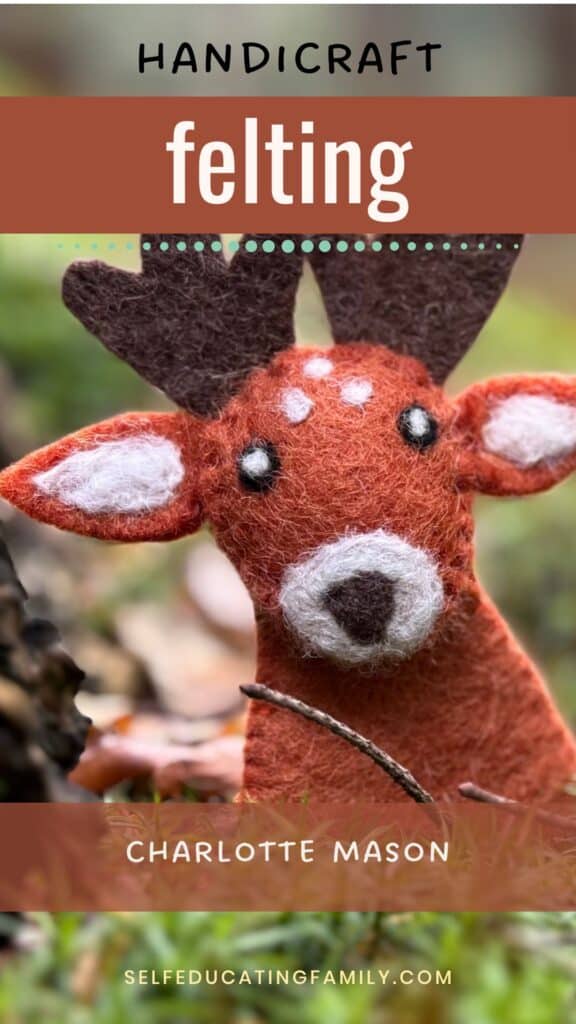
Felting is a hand craft that uses the unique properties of wool to make sturdy little objects, like toys or ornaments, or even applique-type of flat designs. By poking the wool with a sharp barbed needle, the wool tangles and becomes solid.
What can I make with Felting?
Most commonly, people make small figures or toys by felting. Some people also felt designs onto wool sweaters or fabrics.
You can even make your own wool dryer balls, but typically those are felted without needles and instead using water and shrinkage to get the ball to be felted.
Equipment needed
Felting does not take much equipment to get started. Like any craft, if you really get into it, you can of course get more advanced equipment and materials, but here are the basics.
- Wool carding or roving: Note that WoolBuddy is a US Company that has nice beginner kits if you want everything in one package.
- Felting needle Note that this item has finger guards and a wood handle for using multiple needles at once, which makes larger felting projects faster.
- Feting pad Essential. The wool pads are nicer if you are going to get into this handicraft more seriously, but beginners can make do with a foam pad.
- Finger guards Safety item. Those needles are SHARP!! And you are poking right next to your fingers.
Most of this basic equipment and materials can be found at your local hobby store. If you want to start with a simple project, try a cookie cutter shape like I describe below. You’ll need a metal mini-cookie cutter. I used a heart shape.
How to start
A great way to start felting is by making a small felted shape using a metal cookie cutter.
I made a heart this way. Using the cookie cutter protects your fingers a bit more as you learn the motion of felting — the sharp needles have less chance of poking you!
How to make a small felted heart
Note that in the tutorial I watched, the teacher took 5 minutes to do this. It took me 30 minutes since it was my first project.
Time needed: 30 minutes
How to Felt a Mini-Heart
- Prepare your wool.
If you are using wool roving, stretch and bundle the roving so that it is no longer neatly aligned in strands. Note: this is simply to save time. This step is unnecessary for carded wool.
- Safety.
Put on your finger guards.
- Setup your work area.
Place your heart-shaped cookie cutter onto the felting pad and stuff your wool into the cookie cutter.
- Start poking.
Using an up and down motion with no twisting, bending, or angling, move the felting needle in and out of the wool.
- Keep it even.
Move the needle to different spots as you poke it in and out.
- Continue.
Continue until you have a solid heart.
- Finishing touches.
Remove the heart from the cutter and clean up the edges as desired. Note: Be very careful here — without the metal cutter, your fingers are exposed to the needle!
Is this a good Charlotte Mason type of handicraft?
I think this is a good Charlotte Mason type of handicraft for a few reasons.
- The items that you are making are generally curved. Curved edges and shapes allow for the student to decide what is beautiful and “looks right”. They allow the student to exercise care and control of what is made while improving skills.
- You work with natural materials. Wool is a great material to work with. If they’ve knitted or crocheted with yarn, it’s interesting to see this phase of wool and what you can do with it.
- You make fun, useful projects that make great gifts.
- Students have to take care and work consciously or they will stab themselves. Our children are capable of doing “dangerous” things with proper safety and instruction. It’s the same with Sloyd knives— they are extremely sharp and if you were goofing around and not paying attention, it would be easy to get hurt.
- Felting is a very satisfying handicraft that gives a sense of accomplishment.
Beginner felting project ideas
Admittedly, the cookie cutter heart is not that useful of a finished product, but it is a great beginner project to learn the methods to move on to more complex shapes.
Balls and ovals are the next basic projects.
Then attaching shapes together. Making small animals is good for this next level of skills development. Think of snowmen (3 balls attached together) or animals lying down. Work on faces comes next so your animals come to life.
There are lots of great resources out there.
Great resources
I particularly liked “Felts by Philippa“. She had some lovely tutorials.

Felting & a Psalm 23 Unit Study
I learned felting to see if it would be a good Charlotte Mason handicraft to go with the PSALM 23 Unit Study that’s new to the shop. This is a unique take on a unit study since it avoids “pea and stick work” and instead uses the Psalm to guide a dozen Charlotte Mason subjects, including copywork, recitation, dictation, poetry, hymn study, folk song, nature study, handicraft, and more.